“It’s the nature of stock markets to go way down from time to time. There’s no system to avoid bad markets. You can’t do it unless you try to time the market, which is a seriously dumb thing to do. Conservative investing with steady savings without expecting miracles is the way to go.”
– Charles Munger, vice-chair of Berkshire Hathaway (Warren Buffet’s company)
Last week I referenced the fact that ups and downs do not equal each other in investments, and I wanted to elaborate a bit further on that topic.
Numbers can be tricky, math trickier, and statistics can be just downright insane. I’ll deal with statistics another time (next week maybe), but today we will dive a bit into some math (careful, I can get really nerdy really quickly in this space 😉)
Let’s say I have $100,000 that goes up by 20% … how much would my account be worth? $120,000, a $20,000 gain.
What about if that $100,000 goes down by 20% … how much would my account be worth? $80,000, a $20,000 loss.
On the surface these seem to be identical scenarios where ups and downs are the same. But, when we combine ups and downs that is where they stop being equal.
Same $100,000 example: let’s say the account goes up by 20% and then down 20% … it would be reasonable to assume that I would be back to $100,000 but in actuality my account would be worth $96,000.
What?!?!
Let’s do the math.
$100,000 + 20% gain = $120,000
$120,000 – 20% loss = $96,000
$100,000 – 20% loss = $80,000
$80,000 + 20% gain = $96,000
It’s not good or bad, it’s just math. And I believe it is important to be aware of how math works so we can be wiser investors … and wiser shoppers.
Math games are frequently used in retail shopping to make us think we are saving more than we actually are. If I have a 25%-off coupon and an item is already discounted by 25% our brains will think we are saving 50%, but in reality we are saving 43.75%.
$100 item – 25% discount = $75 sale price
$75 sale price – 25%-off coupon = $56.25
If it’s a sale on top of a sale with a coupon the math becomes even more complicated (and the actual savings diluted)
“Save an extra 25% off the already 25% discounted item” plus a 25%-off coupon. It’s not 75% off … here’s the math:
$100 – 25% sale price = $75
$75 – additional 25% discount = $56.25
$56.25 – 25%-off coupon = $42.19
We think it’s a 75% savings, but when the math plays out it’s only 57.81%.
Math is wonderful, but it can be manipulated if we are not careful. Salespeople and politicians can use very crafted math and statistics to manipulate us and paint a story that is very different from reality.
Statistics opens up a whole additional can of worms, I’ll address that next week. To be continued … 😊
Give me a shout anytime I can be of assistance. I know some of these concepts can get a bit in depth.
“History must repeat itself because we pay such little attention to it the first time.”
– Blackie Sherrod, American journalist, 1919-2016
Since we are now officially just over halfway through 2023, I wanted to provide you with a mid-year update.
Before I make these comments, I would like to point out that what happens in any 6-month period of time is fairly insignificant in comparison to our objective of lifetime (and in many cases multi-generational) wealth planning. The last thing I would ever want to do is get caught up in market commentary at the expense of losing sight of our long-term financial goals. That being said, there are a number of interesting observations / learning opportunities the market has provided to us over the last 6 months. In fact, the last 18 months are ripe with lessons for all of us investors to learn from.
Friday, December 30, 2022 the S&P 500 closed at 3,839.50. On June 30, 2023 the closing value of the S&P 500 was 4,450.38. This represents a 15.9% increase in value since the beginning of the year (not including dividends).
The S&P 500 is an index of large U.S. based companies. Other asset classes such as mid-cap, small-cap, international stocks, etc. all had different returns, but for this conversation I will focus on the S&P 500 as that is often considered the best broad-based market index.
So, we had a very solid first half of 2023. This is not particularly surprising if you ask me.
Why? The very simple fact that the market losses from last year made stock ownership available at an attractive discount to investors. So, the buyers come in to scoop up cheap stocks, like they have every other time stocks become overly discounted.
January 3, 2022 the S&P 500 closed at an all-time high: 4,796.56.
159 days later, on June 13, 2022 the market officially entered a bear market (defined as a 20% drop from a previous high), with a closing price of 3,749.63 that day.
The bottom of this market cycle was 121 days later on October 12, 2022 where the S&P 500 closed at 3,577.03.
In the 280 days from January 3, 2022 to October 12, 2022 the market had lost 25.4%.
Let’s pause right here for a moment. October 12, 2022 was 271 days ago. What were you doing on that day? I had to look at my calendar to see what I was doing that day. My guess is that you don’t have a specific recollection of that individual day either. There was no public service announcement “Today is the low point in the stock market, tomorrow starts a new bull market.” There was no airplane skywriter saying “BUY TODAY.” I don’t recall seeing any billboards going up saying “This is the moment you buyers have been waiting for.”
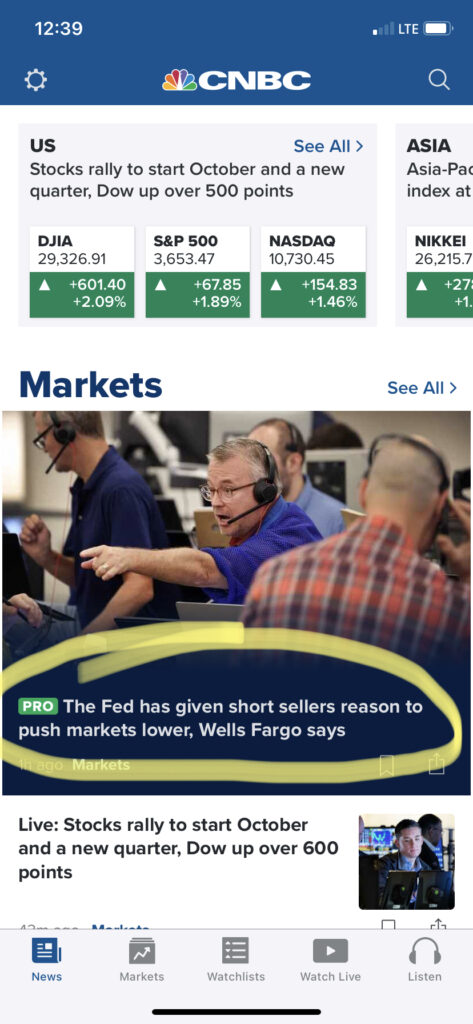
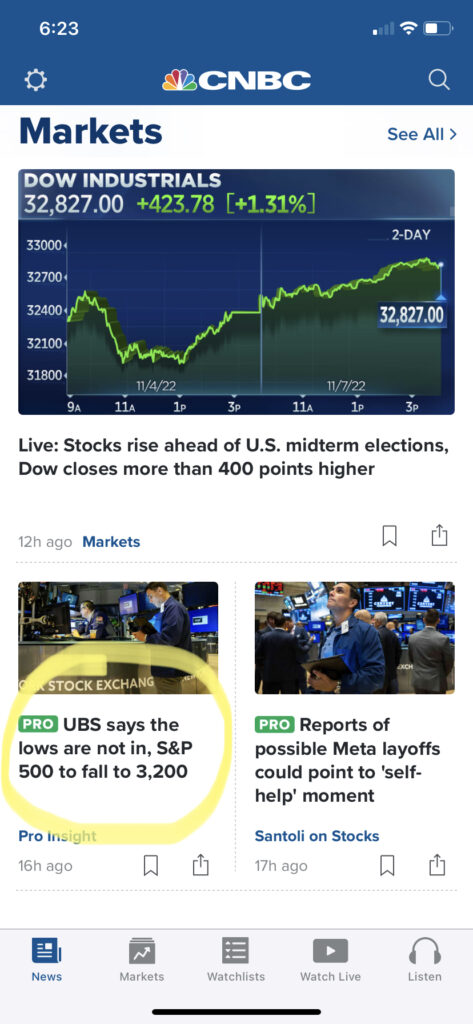
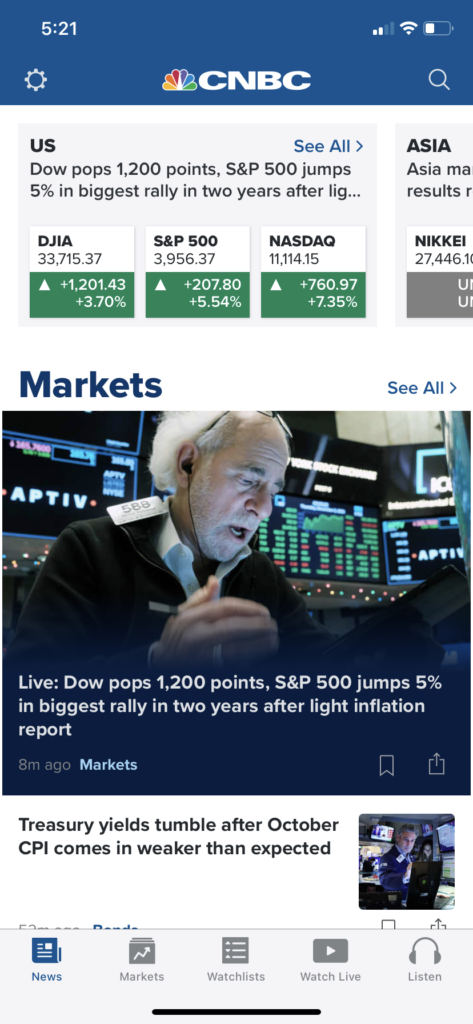
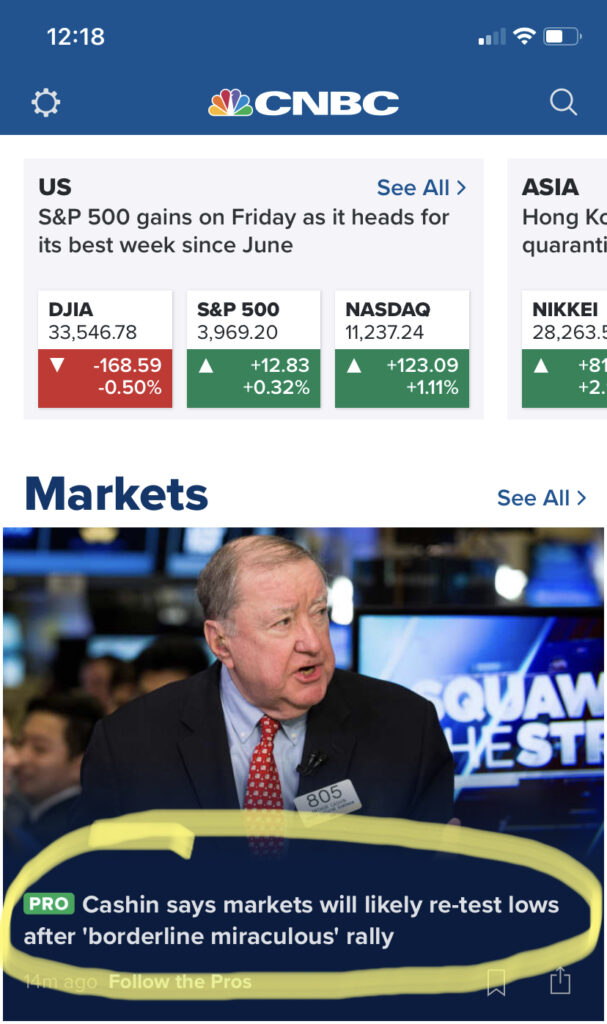
I periodically take screenshots of market headlines, basically because I get a kick out of how wrong all the market gurus and media talking heads constantly are. I went back through my photo album on my phone and searched for screenshots I took closest to the October 12, 2022 market low. All these attached screen shots are from the CNBC app. October 3, 2022 (9 days before market low): “The Fed has given short sellers reason to push markets lower, Wells Fargo says.” November 8, 2022 (27 days after market low) “UBS says the lows are not in, S&P 500 to fall to 3,200.” Two days later, November 10, 2022 “Dow pops 1,200 points, S&P 500 jumps 5% in biggest rally in two years after light inflation report.” The next day (November 11, 2022): “(Art) Cashin says markets will likely re-test lows after ‘borderline miraculous’ rally.” It’s amazing how consistently wrong these people are and yet people still listen to them. That’s a whole other topic worthy of its own Monday morning memo! Be forewarned 😉
By November 10, 2022 (a mere 29 days from the October 12, 2022 low), the S&P 500 closed at 3,956.37, above the June 13, 2022 close that officially started the bear market.
Last month, June 8, 2023 to be precise, the S&P 500 officially entered a bull market (defined as a 20% increase from a previous low) with a close at 4,293.93.
Through June 30th the S&P 500 is up 24.4% from its low point on 10/12/2023 (again, not including dividends).
Two quick observations I think it would be likely for you to point out:
“What about dividends?” All of these S&P 500 values exclude dividends which, as you know I talk about frequently, are a very important component of investing. These losses over the last 18 months are less when you factor in dividends.
“If the market went down 20% and then up 20% why are we not back to break even?” This is a great observation and one I’ll plan on addressing in more depth in next week’s Monday morning memo. But bottom line: ups and downs are not equal in investing. Stay tuned for next week. 😊
What are the lessons we can learn from these last 18 months?
Be patient – successful investing requires patience, there is no substitute for patience. I am not a patient man, I hate waiting in traffic, in grocery store lines, anywhere … but in investing is basically a requirement.
Be diligent – this means tuning out the noise that is all around us … the financial news media, the neighbor who has the market all figured out, the email your distant cousin forwarded to you telling you to sell all your stocks and buy gold. Sticking with the plan even when it’s not easy is key for us investors.
Be wise – I’ve had many conversations where I discuss the “head vs. heart.” The head (the logical part of us) says in a down market “be patient, be diligent, this too shall pass” while the heart (the emotional part of us) is screaming “you’ve already lost 20%, stop the bleeding and get out before you get killed!” Listen to your head.
It’s a tremendous honor to have served you these past 18 months as we have navigated these waters. We will continue to work as hard as we know how to provide you with the best guidance possible going forward as well.
At any point during the journey please do not hesitate to reach out to us if we can support you further.
Over the last few weeks I’ve been going through nerd-ville with P/E ratios, business valuations, dividends, shareholder value, and market commentary. Since it’s a holiday week, let’s have a little bit of fun. 😊
Check out these fun videos that were shared at my church on Mother’s Day and Father’s Day about things that moms & dads never say. There are about 2 ½ minutes each, and I found them super funny and enjoyable.
Things you will never hear Jonathan say:
Let’s try to market time and buy at the bottom and sell at the top.
Focus on short-term returns, don’t get overly focused on long-term success.
Don’t be patient with your investments.
Always trust your gut and make sure to be very emotional about your investment decisions.
Listen to the media and follow everything they say.
Why bother with a financial plan when we can just wing it?
Obviously, if you are working with me you fully understand I frequently say the complete opposite of those above statements. But, sometimes a little comedy to illustrate a point can be effective 😊
Hope you have a wonderful 4th of July and a great week ahead!
This week’s Monday morning memo is coming to you on Saturday as I am leaving this afternoon for a mission’s trip to Guatemala. I will be there for the duration of the week ahead as I help in building houses for those in need in coordination with Hope Project International (whose golf tournament Intentional Wealth is the title sponsor for every December). As a result, I will likely be unreachable this upcoming week, but if you need me email is probably the highest probability of being able to reach me (my understanding is wi-fi is available, but not consistent) . Christy & Carissa are in the office and are glad to assist in any way this week while I am out.
In the meantime, I thought I might use this week to give you a break from my normal commentary and share with you words from another voice / perspective. Please see the attached PDF, in your email, for some commentary from Nick Murray, a financial advisor turned author, who has more than 50 years of experience in the investment world. I have been following him for decades and hope you find his words from this month’s subscription-based newsletter to be insightful.
I look forward to sharing with you what I learn through this experience in Guatemala. I can’t thank you enough for your support of Intentional Wealth as we support those in need through this trip.
“If you can follow only one bit of data, follow the earnings – assuming the company in question has earnings. I subscribe to the crusty notion that sooner or later earnings make or break an investment in equities. What the stock price does today, tomorrow, or next week is only a distraction.”
– Peter Lynch, American investor & mutual fund manager
Last week I got a little carried away about business profits and the amazing opportunity we as investors have to take part in the profits of amazing businesses through ownership in company stock.
Today I would like to talk about one of the most fundamental of investing concepts: price to earnings, also known as P/E ratio.
P/E ratio helps us as investors determine what price we are willing to pay for an ownership stake in a business.
As with many things within the investment space, this can get a bit complicated, but I will try to not get as carried away as I did last week, but no promises. 😉
Let’s pretend that Intentional Wealth generates profits of $1,000,000 per year. This is completely hypothetical (but I can dream, right? 😉)
If someone were to knock on my door and say they would like to purchase Intentional Wealth and they would offer to write me a check for $1,000,000 would I accept that offer? No way! The business makes $1,000,000 a year, why would I sell the business for 1 years’ worth of profits? I could simply work one more year and make that amount. I would tell this person to get lost!
If I accepted the offer (which I would be a fool to do) the P/E ratio would be 1 – the buyer is paying 1 year of business profits for the business.
Now, what if I turned down that first offer and someone else came along and offered me $100,000,000 for the sale of Intentional Wealth … what would I do then? It would be a no-brainer to sell the business … this person (business) is willing to pay me 100 years’ worth of profits! I would have to work 100 years to generate that amount of income. Tell me where to sign! 😊
If this offer came along, the P/E ratio would be 100 – the buyer is paying 100 years of business profits in order to take over ownership.
So, a P/E ratio of 1 is way too low, but a P/E ratio of 100 is way too high. What is a fair number? That is where things get quite a bit more complicated.
Depends on not just the business, but the business outlook, the economic environment, the industry, and expected earnings growth … just to name a few of the factors.
As a reference point, at the end of the first quarter in 2023 (March 31, 2023) the average forward P/E ratio of the S&P 500 was 18.0 (see attached slide for more details). That means that investors are willing to pay 18 years of profits for the ownership of the S&P 500. Now, there are plenty of individual companies in that index that have higher or lower P/E ratios, but that is the average as of 3/31/2023.
As an investor let’s say you could choose between one of two investments:
Investment #1 – company has been around for 100 years and makes consistent, predicable profits, in a stable industry where profits will probably grow around the rate of inflation.
Investment #2 – company has been around 10 years and only recently has turned profitable but has projections to make significant profits in the years ahead in the technology industry.
Which one do you choose?
I probably would think investment #2 because of the greater growth potential.
But what if company #1 has a P/E ratio of 15 and company #2 has a P/E ratio of 40? See where things quickly get complicated?
Apple recently made headlines for becoming the most valuable company in the world. Apple’s P/E ratio is currently around 30. That means that investors are willing to pay roughly 30 years of current profits to take an ownership stake in Apple. If Apple made $1,000,000 a year, then the company value would be $30,000,000 at that P/E ratio of 30.
Compare that to General Motors (GM) who has a P/E ratio hanging around 5.5. That means that investors are willing to 5.5 years of profits to take an ownership stake in GM. If GM made $1,000,000 a year, then the company value would be $5,500,000 at that P/E ratio of 5.5.
So why is Apple roughly 6 times more expensive than General Motors? The overly simple answer is that investors believe that Apple’s future growth warrants the higher price, and that GM will not be able to maintain profit at current levels. Apple is changing the world and investors believe that greater profits will be ahead for the company, so they are willing to pay a premium to be an owner of this ground-breaking company. GM on the other hand is having to make significant investments to transform their fleet to electric vehicles and investors are concerned that competitors such as Tesla may drive GM’s profits lower going forward.
Does that mean Apple is good and GM is bad? No. GM is cheaper, does that make it a better investment? Not necessarily.
The “cheapest” stock in the S&P 500 is DISH Network, which is trading under 2.5. Investors don’t believe that company has long-term profitability sustainability, so that is why it is cheap.
What about Amazon, which trades above 300 P/E? Investors believe that Amazon’s profitability is significantly greater going forward and are willing to pay 300 years of current profits in order to acquire an ownership stake.
Does your head hurt yet? 😉
So many people focus on the stock price (“The stock hit $50 a share this week”), but I am far more concerned with P/E ratios than I am with the stock price when evaluating when to buy, hold, or sell positions in our portfolio.
As a side note, at Intentional Wealth we generally do not recommend or purchase individual stock or bond holdings, instead we utilize ETF and mutual fund strategies in order to benefit from diversification and allowing the experts within those companies we partner with to make individual security selections. We go through a rigorous screening process to determine which fund families, funds, and strategies we will employ for your benefit.
Sorry if this is overly boring or technical, but I just wanted to share some insight into the exceptionally important investment factor of price-to-earning as it is one of the most important components of our investment strategy and structure.
As always, I am glad to discuss further so please don’t hesitate to reach out.
“Business must be run at a profit, else it will die. But when anyone tries to run a business solely for profit, then also the business must die, for it no longer has a reason for existence.”
– Henry Ford, founder of Ford Motor Company
Today I would like to go to the very basic level of business.
What is the purpose of business? Why does a business exist? What do businesses do?
Every business was formed for and exists for one main reason: to make a profit.
When a business ceases to make a profit and does not have a path towards profitability it no longer is a business (think Sears, K-Mart, etc.).
Every investor has one primary objective as well, and it is exactly the same … to make a profit.
Now, in the pursuit of making a profit all sorts of good things develop that you and I benefit from every single day. The pursuit of profit has resulted in diseases being cured, mind-blowing technological advances being made, and progress mankind has experienced that would not have ever occurred if it were not for profit-seeking corporations.
For all the corporate bashing that I hear in the media and from our politicians I will proudly stand up for business and profit-making. (There are plenty of examples and exceptions, but overall, I love business!)
Making a profit is not only not a bad thing, I contend that it is a wonderful thing.
What is so great about investing is that you and I are provided with an opportunity to be amongst those benefiting from the profits publicly traded corporations generate. In other words, we can profit when the companies we own profit. How cool is that? (Nerd alert, I get super excited about this stuff! 😊)
Now, when it comes to equity (stock) investing I want to address the concept of what you get and what you pay.
What you pay is the stock price. What you get is an ownership stake in the company purchased.
To make this as simple as I can, let’s hypothetically say that Intentional Wealth was a publicly traded company with a value of $1,000,000. Let’s say that there are 10,000 shares issued, that would mean that each share would have a value of $100 (10,000 shares x $100 per share = $1,000,000 value). Let’s also assume for this example that Intentional Wealth currently makes a profit of $50,000/year and that the profits grow by 5% per year. (All of these figures are completely made up and Intentional Wealth is not a publicly traded company).
Now, if you purchased 10 shares of Intentional Wealth you would pay $1,000 (10 shares x $100 per share = $1,000 investment). That is your cost.
What do you get in exchange for that $1,000 investment? 10 ownership shares of Intentional Wealth … in this example that represents a 0.10% ownership stake in the company.
Now, there are 2 different ways in which you would potentially profit from this ownership stake.
Dividends
Share value growth
Dividends: If the profits of Intentional Wealth are $50,000/year and you own 0.10% of Intentional Wealth then you would receive $50/year in dividends ($50,000 profit x 0.10% ownership stake = $50 annual dividend).
Now, over time does Intentional Wealth want to increase or decrease its profits? Of course, the objective of the business is to increase profits, that is the objective of every business. In this hypothetical example, the more the profits of Intentional Wealth grow, the more you will benefit from the increase in dividends paid out to you as a partial owner of the company.
As mentioned above, we will assume that the profits grow by 5% in this example. Here’s a table of the dividends pay out each year:
Year
Annual company profits @ 5% growth rate Rounded to the nearest full dollar
Annual dividend paid for a 0.10% ownership stake Rounded to the nearest penny
1
$50,000
$50
2
$52,500
$52.50
3
$55,125
$55.13
4
$57,881
$57.88
5
$60,775
$60.78
6
$63,814
$63.84
7
$67,004
$67.00
8
$70,355
$70.36
9
$73,873
$73.87
10
$77,566
$77.57
11
$81,444
$81.44
12
$85,517
$85.52
13
$89,792
$89.79
14
$94,282
$94.28
15
$98,997
$99.00
16
$103,946
$103.95
17
$109,144
$109.14
18
$114,601
$114.60
19
$120,331
$120.33
20
$126,347
$126.35
TOTAL
$1,653,294
$1,653.33
So, in this example company profits grew over 20 years from $50,000 to $126,347 … and total profits over that 20-year period of time were $1,653,294.
That means that as a 0.10% owner (your 10 shares) you would have received $1,653.33 in dividends over the 20 year period of time (remember, your original cost of purchasing a 0.10% stake in the business was $1,000) and you still maintain the ownership in the business that you could sell or continue to collect the dividends from.
Share value growth: If Intentional Wealth continues to grow its profits, is the company going to be more valuable or less valuable? Of course, it should be worth more.
As the chart above illustrates, if the profits grow from $50,000/year to $126,347/year 20 years later (roughly 250% growth) we could reasonably assume the value of the business would be worth 250% more as well. That would put the value of Intentional Wealth at $2,500,000 instead of $1,000,000.
Based on that assumption, as a 0.10% owner you would be able to sell your ownership stake to someone else for $2,500.
So … when we take a look at both of those factors, we would see a $1,000 investment into a business paid $1,653.33 in dividends over 20 years and then the ability to sell that ownership stake for $2,500 in 20 years. That means the total value of your investment was $4,153.33. You turned $1,000 into $4,153.33!
Price is what you pay, value is what you get.
Of course price matters, it matters a lot. You never want to overpay for an ownership stake in a business (or anything for that matter), but I never what to lose track of what you get when you invest … you get the amazing ability to take an ownership stake in some of the best run, most profitable companies every created. That ownership stake entitles you to share in the profits (dividends) and share in the growth of the company (share value growth).
If you take an ownership stake in a company for $10 per share and a month later the company stock price is $9.50 I would contend it does not really matter. You still have the same ownership stake in the same company and still can benefit from the profits of that ownership stake (dividends, future share value growth). If it is a well-run, profitable company the temporary reduction in stock price just creates an opportunity for you to potentially take a greater ownership stake at a lower price, it does not mean it was a bad investment at $10 per share.
If you’re waiting for the stock price to drop to $9.00 a share that may never happen and you may miss out on an opportunity to take an ownership stake in a great company, or you may have to pay $11 or $12 to acquire an ownership stake at a future point because you were waiting for a $9 share price that never happened.
Pay a fair price for an ownership stake in a diversified group of high-quality companies and then let the companies do their thing … make a profit! 😊
This is far more complicated than I have outlined here, we are really only scratching the surface, but I think I probably have already overdone it for today. 😊 I’ll probably use next week’s memo to address this a little bit further as there are some really valuable concepts to grasp within this arena.
As always, please never hesitate to reach out to discuss further any of the topics I bring up in these weekly memos.
Hope it is a productive and profitable week ahead!
“I learned that courage was not the absence of fear, but the triumph over it. The brave man is not he who does not feel afraid, but he who conquers that fear.”
– Nelson Mandela, former president of South Africa
My friends, this morning I would like to offer a warning: there are people who want to divide us and scare us.
These people are not our friends, I would go so far as to call them our enemies. They don’t know us, they don’t care about us, they are simply using us. And they have a very intentional recipe to sabotage us … because they make a fortune by doing so.
I am talking about the media, in particular for this memo, the financial media.
Now, the media and politicians both understand and utilize one very key, powerful emotion for their benefit: fear.
With the political season beginning to heat up, over the next 17 months until election day you will hear both sides of the political aisle trying to scare you.
Prepare yourself … I predict you are going to hear something along the lines of this:
Biden – the Republicans are dangerous! If you vote for them you are giving up your liberties and we may never recover from the devastation they will bring upon our country. I am terrified of what will happen to the United States if he becomes president. Vote for me because I am not as scary.
Trump / DeSantis (after beating each other up in the primary) – the Democrats are dangerous! If you vote for them you are giving up your liberties and we may never recover from the devastation they will bring upon our country. I am terrified of what will happen to the United States if he becomes president. Vote for me because I am not as scary.
The more scared you are the more likely you are to vote. Neither side is going to say, “I think I have a better agenda for our nation, but the world is not going to end if I don’t get elected.” That does not drive people to the polls, so they instead they attack the other candidate and try to whip up their base to show up in big numbers. It’s the proven recipe that both sides employ every single election season. It seems like nothing is off limits to scare people to the polls.
Who wins when they do this? I don’t know about you, but I don’t think the citizens win from this kind of political system. After watching a debate I find that I am exhausted. A large portion of our society is so turned off by this campaigning style that they just tune out. The politicians may win, but the people lose.
I submit to you it’s exactly the same with the news media.
Think about after 9/11 … we were glued to our TVs. I probably watched the news for 8+ hours a day for a few weeks in that timeframe. The media loved it! The more people who tune in the more they can charge for a 30 second commercial. The more they can charge for commercials the more money they make. So, the news media has an incentive to scare you. The more scared you are the more money they make.
This is quite disgusting if you ask me. But it works, so the media will continue to do it.
My position: “Investing involves short-term fluctuations, but incredible long-term potential for gains. It requires patience and no one, I repeat no one, can time the market. The best way, in fact I would contend the only way, to be a successful long-term investor is to simply ride out the short-term bumps in order to profit the long-term returns the market provides. Patience and discipline is the recipe for investing success.”
You will NEVER hear that message on CNBC, Fox Business or any other financial news outlet! Never. Why? Because, if you received that message then you would realize that all their coverage, that sensationalize virtually every single event, DOES NOT MATTER!
You would realize it does not really matter what the fear-of-the-day message they are delivering is and you would simply turn it off realizing your life is better without them. They cannot allow that to happen … if you turn off the TV, stop clicking on the articles, and cancel your newsletter subscriptions then their paychecks stop. So, instead they sensationalize stories … “bombshell developments,” “shocking revelations,” “Breaking news.”
For the good of your mental wellbeing and your financial wellbeing I can’t in strong enough terms encourage you to turn that crap off!
One of my favorite bands Switchfoot has a song called “Selling the News.” Here’s a few lines from that song:
America listens as the story is told
With the eye on the truth as the story unfolds
But the ratings determine which story was sold
We’re selling the news
Substance, oh, substance where have you been?
You’ve been replaced by the masters of spin
Who make good looking books and write history in
We’re selling the news
We are patient, disciplined investors who understand that short-term headlines will not dictate our long-term investment plan. We will not be vulnerable consumers of the garbage the media is selling. We refuse to allow the media to have that level of power of over our lives. We understand it is unhealthy and unprofitable.
Instead, we will stay focused on our financial goals and the plan we have established to accomplish those goals. We will accept, even embrace, that short term volitivity is the necessary price to pay in order to accomplish these cherished goals.
I know I probably send a message of this type at least once a year, but it is so important to reinforce this message. The enemy (the media) can sneak up on us and suck us in if we are not diligent to their schemes.
It’s an honor to serve you as we navigate these investment waters together. If there is anything my team and I can do to support you further, please let us know.
Good morning, happy Monday, and happy Memorial Day!
“A hero is someone who understands the responsibility that comes with his freedom.”
– Bob Dylan
Originally Memorial Day started out being called Decoration Day and it originated shortly after the Civil War. That was a war that cost 620,000 precious human lives (roughly 1 in 50 Americans at the time).
As our nation sought to heal following that conflict that took so many lives, we recognized the need to remember their sacrifices.
We owe an unpayable debt of gratitude to all our men and women who serve and have served. Your sacrifice, and the sacrifice of your family, is the only reason we are free. THANK YOU!!!
Memories are so fleeting and it is so easy to forget.
Following the 9/11 terrorist attacks the saying “We will never forget” became a very popular. Unfortunately, I fear that far too often we do forget.
We forget the sacrifices those before us made for us to live in the freedom we enjoy today. We forget to say “thank you.” We forget to count our blessings.
Our human brains tend to discount the past as we spend so much effort on the NOW. That is why Memorial Day is such an important day … to remind us to remember!
In investing this is most certainly true as well … how easy is it to forget the fundamentals and get caught up in the flavor-of-the-moment media headline? More on that another day 😊
Life is fleeting. Not a single person reading this is guaranteed to live through the day. We all are rapidly approaching our expiration date on this earth. We must take the time to remember that “the good old days” are maybe the days we are in right now. Take the time to enjoy them. Smell the roses. Hug your family. Enjoy the journey.
Thank you for allowing me to a part of the story you are writing. Enjoy the week ahead!
“The joy is in the journey, not the destination. We have a better chance of seeing where we are when we stop trying to get somewhere else.”
– John Bingham, author
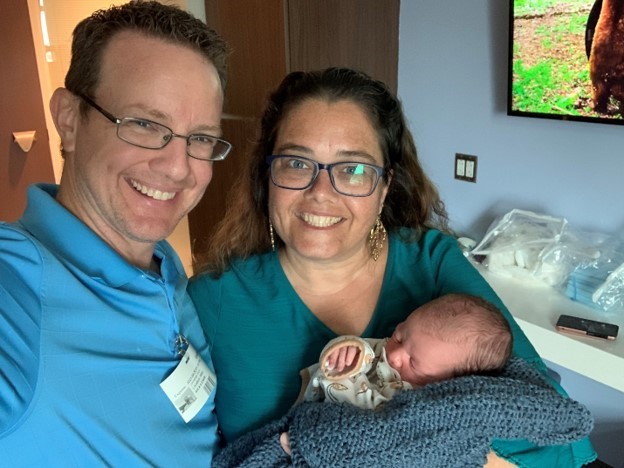
My friends, a few weeks ago my wife and I had the joy of welcoming our 2nd grandchild to the world.
There are few things in life that give you a better perspective than holding a newborn precious baby in your arms.
When we look into the eyes of a baby, I think we have to realize the incredible gift that life is and the tremendous opportunity we all have to make an impact in the world we are in.
My friends, you and I are alive and breathing right now. I believe it is not an accident that God put us on this earth for this time. We have valuable, meaningful contributions to make in the lives of our family, friends, loved ones, co-workers, neighbors, communities, and the world.
In a world that has so many problems, our minds can so quickly and naturally go to negative things. China, the national debt, Russia, Ukraine, the southern border, inflation, monetary policy, crime, the economy, recession, the debt ceiling, you name it … the entire media industry makes a living shoving that crap down our throats, but I’ll address that another Monday morning memo (stay tuned 😊).
If you are anything like me, it is so easy to get discoursed with everything that is going on in the world. At times it seems like the entire world is completely out of control! And frankly, it seems like there is not a lot that you and I can do about it. There are crazy, confused, evil people that are in our society … there always have been, and always will be. We can’t change that; we can’t control that. What we can change and do have control over is our attention, our attitude, our perspective, and our actions.
We may not be able to change the world, but we can change how we see the world and thus change our world. And I believe that if we change how we see the world that can transform the world.
On this topic, one of my favorite quotes is from Mother Teresa:
People are often unreasonable, irrational, and self-centered.
Forgive them anyway.
If you are kind, people may accuse you of selfish, ulterior motives.
Be kind anyway.
If you are successful, you will win some unfaithful friends and some genuine enemies.
Succeed anyway.
If you are honest and sincere people may deceive you.
Be honest and sincere anyway.
What you spend years creating, others could destroy overnight.
Create anyway.
If you find serenity and happiness, some may be jealous.
Be happy anyway.
The good you do today will often be forgotten.
Do good anyway.
Give the best you have and it will never be enough.
Give your best anyway.
In the final analysis it is between you and God.
It was never between you and them anyway.
My friends, we get one shot at this life. Whether you are a few days old like my grandson, or at the midlife point (like me, yikes!), or you are on the later years of life’s journey, I believe we all have a reason for being here and a purpose to pursue.
Each one of us has a unique, special contribution to make to this world. We have different circles we run in, unique perspectives to share, and a life story that is unlike anyone who has ever lived before or will ever live again. What do we choose to do with that gift?
I am so grateful that you are in my life … I am blessed to work with amazing people who are making this world a better place. What a privilege it is for me to serve you as we impact the world together!
My life is better because you are in it.
If there is any way I can support you along your journey, please do not hesitate to reach out.
“Some people get rich studying artificial intelligence. Me, I make money studying natural stupidity.”
– Carl Icahn, American financier
Last week I referenced this chart (also included as an attachment) that shows the S&P 500 from 1980 through the 1st quarter of 2023. Today I’d like to dive in this a bit more with a few comments / observations.
You will see from this chart that from 1980 – 2022 the S&P 500 had 32 up years, 10 down years, and 1 year with a 0% return (2011). The average rate of return during that 43 years was 8.7% (not including dividends which are a huge part of investment returns … see Monday morning memo from 8/8/2022).
Now, that’s all great, but we don’t live and evaluate and make decisions on a decade-by-decade basis, or even a year-by-year basis. We as human beings tend to look at things RIGHT NOW! What is going on RIGHT NOW is what takes our focus.
Right now the market has lots of things to worry itself with: inflation, fed policy, the banking situation, war, trade policy, regulations, legislation, and recession fears just to name a few. It is not an easy time to be an investor.
Please allow me to ask a question: WHEN has it EVER been easy to be an investor?
If I may draw your attention again to the chart above, you will see red dots with a negative sign in front of them. That represents intra-year drops, in other words the largest market drops from a peak to a trough during that year.
For example, 2022 saw an S&P 500 return of -19%, but at one point during the year (October 12, 2023) it had dropped as low as 25%. That means the S&P 500 was up roughly 6% from its 2022 low on October 12th to December 31, 2022.
Was 2022 an easy year for investors? Most certainly not!
In 2021 the S&P 500 returned a positive 27% rate of return, but there was a 5% drop during the year. In hindsight 2021 was a very calm year for investors, only a 5% drop during the entire year, which is very calm by historic precedents.
Was 2021 an easy year for investors? Well, if you look at the chart above you might likely come to that conclusion since it was one of the least volatile years over the last 4 decades.
Did you feel great about investing in 2021? May I remind you what 2021 brought? January 6 Capital riot, the inauguration of a new president and single party control of all 3 branches of government, the impeachment of a president, record-setting government spending, a national debt that was growing exponentially, Covid-19 deaths that year were approximately 460,000 according to the CRC (60,000 more than 2020), the rollout of a controversial vaccine, vaccine mandates, and the US withdraw from Afghanistan just to name a few. I don’t remember having a single conversation with any of you in 2021 where you said, “The world is in a great place and I feel at complete peace in investing right now.”
What about 2020 … was that an easy year for investors? Heck no!!!
If someone invested money in the S&P 500 on January 1, 2020, and then took a one-year nap and woke up on December 31, 2020, they would see a 16% gain and probably think it was a great year. Of course, anyone who was awake in 2020 would come to a completely different conclusion! We saw the S&P 500 drop 34% from February 19, 2020 to March 23, 2020 … but it ended the year with a 16% positive return. Crazy volatility, but a very profitable year for those who stayed the course.
Each year had its own stories of challenges that had to be addressed and struggles that had to be worked through, but you can see the profitability that has occurred over time for a patient investor.
You can also see that oftentimes there is no rhyme or reason for market movements. They cannot be predicted; they cannot be timed. The only way I know of to fully benefit from the returns the stock market provides is to patiently ride out its temporary downturns.
Here’s the bottom line: it is NEVER easy to be an investor. There is ALWAYS something (usually many things) to be concerned about. We invest not because the world is a perfect place without concerns, we invest because we believe that history teaches us that taking an ownership stake in profitable businesses provides us with the greatest possible opportunity to maximize our wealth (and thus maximize our lifestyles, impact, and legacies).
Thank you for trusting me to help you navigate these investment waters.